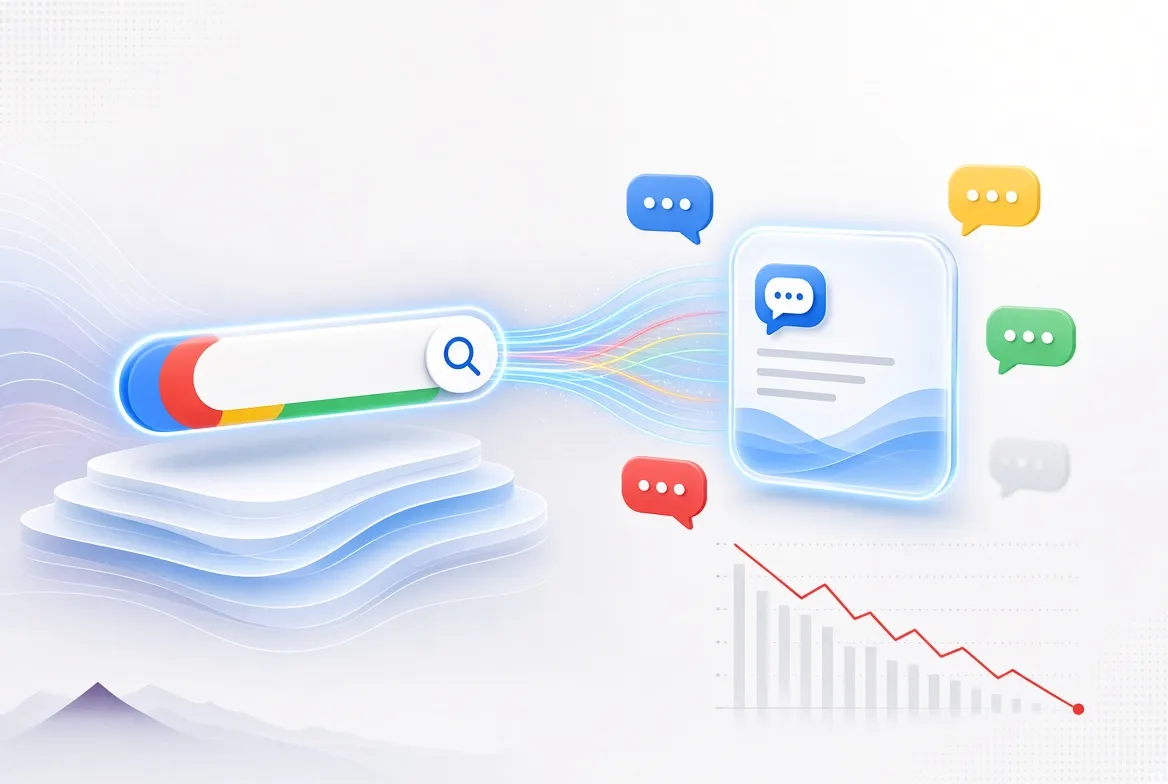
One thing is clear from Google’s latest earnings update. Its core business, search advertising, has already seen the effects of the rise of AI chatbots. Alphabet’s third-quarter earnings showed a 12% slowdown in search revenue growth. That’s a sharp drop from 17 percent in the last quarter and 19 percent earlier this year. Executives acknowledged openly that Google’s own AI Mode is now earning less money from the queries people are asking than traditional search results.
This is not only a story about the share price of one company. This is a reflection of a larger change in the way people are searching for information online. More users are using tools like ChatGPT, Claude and Google’s AI Overviews to get direct answers instead of clicking through a list of blue links. For South African businesses that rely on Google to drive enquiries, leads and sales, the change has practical consequences.
What Google Actually Said
One reason search advertising missed expectations was the strong growth in AI Mode queries, Google leadership said on the earnings call. AI Mode has fewer ads at this time and answers questions in a conversational style. And even when ads do appear, they generally make less money per query than traditional search results.
At the same time, external AI chatbots are taking some users away from Google altogether. The company has long said its own AI features would protect its place. Recent figures suggest it is tougher to transition. Google is testing and launching ads within AI Overviews and AI Mode, including in other countries across the globe. The direction of travel is clear – commercial intent is not just expressed through traditional search results.
Why This Change Matters for Discovery
For years, most digital marketing strategies have treated Google as the main channel for discovery. A well-optimised website could catch people who were actively looking for products or services. When AI tools answer the question directly, the chance for a click often vanishes.
That doesn’t mean search is dead. And a lot of high-intent queries still occur on Google. Especially when people are comparing options, checking local availability or ready to purchase. But the route has been changed. A user may ask an AI chatbot a question about a topic and later in the decision process turn to search or social media. If a brand is only optimising for the old ten-blue-links format, they risk being less visible earlier in that journey.
South African consumers are no different. “Mobile usage is high and a lot of people are already using AI tools along with Google. If you sell services, products or expertise, you need to think about how you appear in both traditional results and AI-generated answers.
What This Means for Your Online Marketing
The conclusion is that it is more risky now than it was to use a single channel. Strong SEO is still important because it still drives valuable traffic and also feeds the content that artificial intelligence systems learn from. At the same time, businesses need to consider how their brand is perceived and referenced by generative AI tools.
That’s where generative engine optimisation, or GEO, comes in. GEO doesn’t just rank you. We make your expertise clear and credible, so AI models are more likely to include you as they answer relevant questions. Good clear structured content that shows knowledge tends to do better in both environments.
Paid search is also changing. With Google introducing more opportunities for ads within AI experiences, the balance between organic and paid visibility will keep changing. Businesses that keep a close eye on performance and experiment with new placements are better equipped to adapt.
Practical Steps for South African Businesses
First, check out your current content on your website. Does it clearly explain what you do, who you help and why you are a credible choice? Artificial intelligence systems will prefer information that is accurate, specific and consistently presented across the web. Vague or thin pages are less likely to be cited.
Then, double down on the fundamentals of SEO. Technical health, relevant content and real authority signals are still important. Solid SEO will make your brand a more trusted source in the eyes of search engines and AI tools.
Think about how you can expand the ways that people can find you and engage with you. Useful social media content, email nurture sequences and well managed paid campaigns can catch people’s attention at different stages. Many South African companies already mix search with social and email; the current environment just makes that balance more important.
Finally, check how AI features appear for your top search terms. Ensure that your brand is mentioned in the answers generated by AI and that the information is accurate. Small changes to the structure and clarity of content can increase the chances of correct inclusion.
Fuzion Digital works with businesses across Gauteng, Cape Town and the rest of South Africa on these very challenges. The team is a performance-driven Google Partner, blending SEO and SEM with generative engine optimisation, content strategy and continuous analytics, keeping clients visible as search behaviour evolves.
Looking Ahead
Google’s admission that AI chatbots are hurting its bottom line confirms what many marketers have observed for months. Discovery is more fractured now. Traditional search results still count, but they are not the only place where decisions are influenced.
South African businesses that take this opportunity to strengthen their content, demonstrate their expertise and balance their channels, will be better equipped. Those looking to return to the old model may find there are fewer clicks waiting for them.
If you’d like to see how your current search and content strategy is set up for both traditional results and AI-driven discovery, contact the team at Fuzion Digital. To start the conversation telephone 021 180 2565, email info@fuziondigital.co.za or visit the contact page on the website.